

Curriculum at Queen's College, London
At all levels, our aim at Queen's is to provide a broad and balanced curriculum with scope for pupils to pursue their own interests as these emerge. We do not have a 'blocking system' at GCSE or A-level. The timetable is constructed each year around our pupils' choices with the intention that everyone's individual needs can be met.
Below you will find further details about the curriculum at Queen’s for each year group.
-
Years 7, 8 and 9
For their first three years at Queen's, pupils study the following subjects:
Mathematics History English Geography Science (Biology, Chemistry & Physics) Philosophy, Theology & Ethics Computer Science Art French Music A second Modern language* Drama Latin and Classical Civilisation PSHE Games PE Dance Thrive (Resilience, Truth & Kindness)** *In Year 7, pupils undertake a term each of Italian and Spanish as part of a wider programme of language and linguistics. In Years 8 and 9 they choose one of these to study as their second modern language.
**Thrive is only part of the curriculum in Years 7 and 8.
Games, PE and Dance are also part of the curriculum at this stage. -
Years 10 and 11
In these years, pupils study for nine or ten GCSEs or iGCSEs.
*Compulsory subjects
Mathematics* At least two Science subjects* (choose from Biology, Chemistry, Physics and Computer Science) English Language* A second modern Language English Literature* Future Frontiers* Latin Religious Studies A modern language* (including French, Italian or Spanish) Art A third or fourth Science Music History Drama Geography Dance As well as their examination subjects, pupils are required to take Games and PSHE, which includes Careers.
For complete information about GCSE choices at Queen's College, London, read and download our GCSE Information Booklet, updated for 2026-2028.
-
Sixth Form
In Year 12 pupils usually select three A-level subjects, although in some circumstances pupils will choose four.
Alongside their A-levels, many pupils choose to complete the Extended Project Qualification (EPQ), worth half an A-level, which offers an exciting opportunity to research an area of personal interest in depth and develop valuable independent study skills. Others may choose to complete a Sports Leadership Award or take part in Model United Nations or the the Young Enterprise programme.
In addition, all pupils have periods of PSHE and Physical Education each week.
Wednesday afternoons are dedicated to voluntary work and work experience at a range of companies and organisations in central London.
Read more about Sixth Form at Queen's College, London.
Future Ready Curriculum
Queen’s pupils are dynamic, intelligent and interested in the world around them. In an ever-changing world, we know that it is important to prepare them for their futures. We have an extensive Futures & Innovation programme which include the Queen's Diploma and our Future Frontiers qualification, both of which encourage pupils to develop interdisciplinary skills that will allow them to adapt to changes that are taking place at pace. We are also proud to be part of the School Directed Courses Consortium (SDDC) which is dedicated to the development of a future-ready curriculum.
To support future choices and help pupils explore their interests, all are given access to platforms such as Unifrog from Year 7, as well as opportunities to take part in a variety of initiatives, from the Girls Human Rights Hub, to the QCL Innovation Council. In Senior College (Sixth Form), students complete valuable work experience on a weekly basis at a variety of work places in the local area.
It is also highly important for our staff to be ahead of the curve with the latest developments in Futures & Innovation – we are part of the Artificial Intelligence Education Oxford University (AIEOU) research hub, as well as being on the panel for AI Edify, a collective of teachers across the UK who are invested in understanding how AI may be implemented in educational settings.
-
Futures & Innovation Programme
Our Futures and Innovation programme has been substantially developed over the last few years.
This includes:
- Exploring other routes such as degree apprenticeships. Our Careers Fair includes apprenticeship providers from many different sectors and, through the Southwark Schools’ Learning Partnership, we have been able to access events across other schools relating to this.
- Work experience through our extensive Professional Skills course and work experience/voluntary service programme for Year 12 students who complete this every Wednesday afternoon.
- All students from Year 7 upwards have access to Unifrog, giving them expert and detailed advice for careers and higher education.
- Our extensive programme of events range from a design workshop from Experience Haus for Year 9 to AI and Careers workshops for all Year 10 and Year 12 students.
From Year 7 to Year 13, all students complete Futures & Innovation lessons in PSHE through Unifrog, following the CDI framework:
Year 7:
- Exploring dream jobs
- What is a career?
- What is an entrepreneur?
- Work-life balance
- Careers and the future
Year 8:
- What are my interests?
- Superhero CVs
- Challenges and rewards of work
- Creating the life you want
Year 9:
- What comes after school?
- Choosing what to study at KS4
- Control of your career
- Managing your money
- The labour market
Year 10:
- Exploring employer profiles
- What career is best for me?
- Work experience
- Wellbeing in the workplace
Year 11:
- Making choices post 16
- Apprenticeships vs higher education
Year 12:
- Post 18 choices
- Setting career goals
- How to network and be enterprising
Year 13:
- Personal branding: your CV and online profile
- The basics of interviews: in person and online
As well as following the framework above, our students take part in the following initiatives:
- Year 7 pupils are a key part of our Girls Human Rights Hub and take part in an annual careers workshop as well as attending whole school events such as the biennial Careers Fair. They also take part in the Young Entrepreneurs Academy, allowing them to learn important employment skills as well as a certificate from University College London.
- Year 8 pupils take part in the Tycoon Enterprise Programme, within their Thrive lessons. Through this, they develop exciting business ideas and promotional videos, presenting these to staff and students.
- Year 9 pupils take part in an Experience Haus workshop, developing cross-curricular design and thinking skills, applying this to a ‘real-world’ scenario before presenting their ideas. After that, they apply their understanding from this workshop to the Samsung ‘Tech for Good’ competition, in follow-up lessons.
- Year 10 students are a key part of the Southwark Schools’ Learning Partnership (SSLP) Ambassador Programme and are invited to take in IPA’s Advertising Unlocked Day, as well as help with important events within Careers Week. From September 2026, IJ (Year 10) pupils will complete our exciting, bespoke interdisciplinary qualification ‘Future Frontiers’.
- Year 11 students are given free access to the Morrisby Online Test and this also includes a one-to-one interview with a Morrisby advisor.
- Year 12 students are given free access to MyUniChoices followed by individual interviews and complete an ‘Introduction to Professional Skills’ course prior to starting their weekly work experience placements. They also have the opportunity to take part in Young Enterprise.
- In their final year at Queen’s, Year 13 students learn more about interview skills and finding the right job, preparing them for university and future employability.
-
Future Frontiers - unique to Queen's
Queen’s College, London is proud to announce Future Frontiers — a pioneering new interdisciplinary qualification launching in September 2026 and bespoke to Queen's.
Developed by Natasha Fenwick, Director of Futures and Innovation, and endorsed by EDUQUAL, this course redefines what learning looks like for the next generation of thinkers, creators and leaders.
At Queen’s, we’ve always believed education should prepare young people not just for exams, but for life. Drawing on insights from global research, universities such as Oxford and Edinburgh, and organisations including the OECD, the course encourages critical and interdisciplinary thinking across disciplines such as Neuroscience, Psychology, History of Art and Economics. The programme develops key skills for the future, including research, writing, creativity, presentation and collaboration, through workshops and real-world applications. Assessment includes academic posters and TED-style presentations that mirror the way knowledge is shared in universities and industry today.
As Richard Tillett, Principal of Queen’s College, London, explains:
“We were the first to give qualifications to girls – and we’re proud to be first again in shaping what the future of learning looks like.”
Queen’s College, London is now an EduQual-approved Centre. EduQual is a regulated awarding body, approved by SQA-Accreditation – a globally recognised national qualification regulator in the UK – and a full member of the Federation of Awarding Bodies.
Future Frontiers sits within the Queen’s Diploma, a broader initiative that embeds skills such as leadership, enterprise, and ethical innovation throughout the curriculum.
The qualification has been endorsed by Martin Adams, entrepreneur, Harvard graduate, and advisor to the World Economic Forum:
“This is exactly the kind of course young people should be experiencing today – forward-looking, participatory, and rooted in the kind of creative, community-based learning that truly prepares students for the future.”
The course also features contributions from David Robson, award-winning science writer and author of The Expectation Effect, who introduces students to “future thinking” as part of the What Does It Mean to Be Human? module.
Watch the announcement video
Endorsed by Martin Adams, Entrepreneur and World Economic Forum Global Innovator
Martin Adams is an entrepreneur, World Economic Forum global innovator and Co-Founder of several companies. We are delighted that Martin has reviewed and endorsed the Future Frontiers course.
-
Quality in Careers Standard approved - Education Development Trust
Queen's College, London holds the national Quality in Careers Standard accreditation through the Education Development Trust. This is a recognition of our exceptional careers education, information, advice and guidance provision.
-
Student Involvement
- Our students are a key part of our events and have helped to plan a successful biennial Careers Fairs.
- Our Year 10 students have become Southwark Schools’ Learning Partnership ambassadors. This year, they worked with other schools in this partnership to create an exciting and innovative AI-focused platform.
- We have expanded our use of the student voice, to inform our initiatives. Students are asked for feedback on the programme and focus groups have been consulted on new courses we are building.
- Our Innovation Council, comprised of students from all year groups, meets several times every term to discuss Futures & Innovation initiatives, taking the lead in implementing their own ideas as well.
-
Local Market Information (LMI)
- We are fortunate to be located in Central London – many students have completed their placements in local organisations, such as the Harley Street Specialist Hospital, Queen’s College Preparatory School, Springer Nature and Sellar amongst many others.
- Students have access to LMI through Unifrog lessons and information.
-
Partnerships
The College works in partnership with:
- MyUniChoices – all Year 12 students complete this, helping them with university choices.
- Parents, carers, alumnae and further contacts who enrich the Careers Education and Guidance programme, provide work experience and other opportunities.
- Queen’s College Preparatory School.
- Southwark Schools’ Learning Partnership schools.
- Morrisby Careers Testing and individual interviews for all Year 11 students.
- Companies and organisations including Marylebone Library, Re:Skinned, Sellar, Springer Nature and many others.
- The Girls Human Rights Festival and Hub – a GHRH Hub has been established at Queen’s and, as part of this, students have taken part in a Young Lawyers’ Symposium, a GHRH Awards Dinner, weekly meetings and assemblies (Prayers) and fundraising events such as the GHRH Film Night.
- Local primary schools have been invited into Queen’s for after-school sessions, with more planned in the near future.
Teaching and Learning
At Queen's, we are dedicated to fostering a dynamic and enriching learning environment that empowers pupils to thrive. This section of the website has been curated by Dr Paul Davies, our Deputy Head - Academic.
-
Our Approach
Our approach to teaching and learning is grounded in educational theory and designed to inspire curiosity, critical thinking, and a love for knowledge. We believe that a strong partnership between school and parents is essential for a child's holistic development. Here's a glimpse into our approach and ways you can support your child's educational journey at home.
Educational Theory in Action
Educational theory helps explain what works in the classroom and why. An important part of our work is to help staff make sense of current academic thinking and share strategies which allow this to be put into practice. This is done through a termly focus on a specific aspect of teaching and learning (our Teaching & Learning Themes) which includes weekly staff training, sharing of resources and good practice and discussions with pupils how learning strategies and expectations.
Our T&L Themes cover lots of different ideas in educational theory that are central to our thinking at Queen's:
- Pupil-Centred Learning
- Inclusive Instruction
- Incorporating Education Technology
Working Together
Another aspect leading to pupil success comes from the relationship between the College and parents. There are various ways that parents can help supporting learning at home. For example:
- Encourage reading
- Establish a homework routine
- Communication
- Curiosity and exploration
- Encourage a balanced lifestyle
-
Resilient Ready at Queen's
At the College, we place a strong emphasis on fostering resilience in our pupils. In the dynamic landscape of modern schooling, where pupils navigate a myriad of academic and social pressures, developing resilience is crucial. By instilling resilience, we empower our pupils to face difficulties with a positive mindset, learn from setbacks, and develop the grit needed for success.
We have encapsulated this with the phrase ‘Resilient Ready’ which is the focus of our Teaching & Learning.
Some of the strategies we are exploring are:
- The Learning Pit - a model that supports the ways in which we think about, and articulate, our learning
- Encouraging perseverance
- Role modelling resilience
- Creating a "mistake friendly" environment
-
'Back to School' Sessions
Modern school is a very different place than it was even just 10 years ago. These differences have been driven by a range of factors including: the incorporation of educational theory into the work of schools, different social pressures that children now face (including the rise of social media), assessment pressure and a curriculum which is increasingly linked to public examinations.
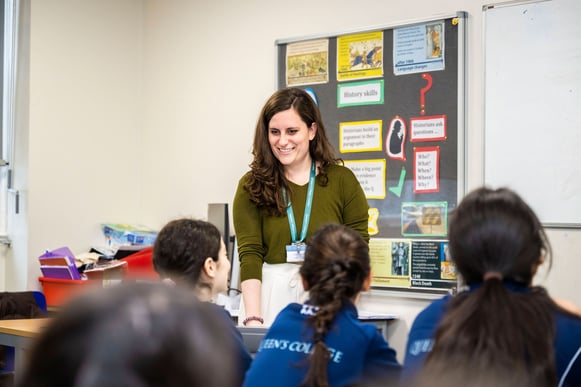
At Queen's, we have developed the 'Back to School' sessions, a series of termly workshops designed to give parents a better understanding of their daughter’s experience at school.
Each 90 minute workshop focuses on a different theme (e.g. neurodiversity, resilience) and involves a mixture of presentations, discussions, tasks and practical advice and support.
Academic Enrichment
At Queen's, we are passionate about creating a community of life-long learners who will inspire the world.
During their time at the College, we ensure that pupils make good use of our extensive Academic Enrichment programme, which provides them with a very wide range of learning opportunities. All teachers work hard to provide engaging enrichment in and out of the classroom, allowing pupils to nurture their curiosity and grow academic independence across all subjects.
-
Scholarship Programme
Scholars follow an intensive but invigorating study programme at Queen’s College. The aim is for pupils to not only further their own learning and creativity but to instil and support scholarly behaviour in all pupils across the College.
All teachers at Queen’s College are passionate about pupils’ learning beyond the classroom. They have worked hard to provide many enrichment opportunities in their subjects.Read more about our Scholarship Programme here.
-
Clubs and Societies
Learning extends far beyond the classroom at Queen's. With more than 70 clubs and societies available across Sport, Music, Drama, the Arts, STEM, Languages, Leadership and Academic Enrichment, every pupil has the opportunity to discover new interests, develop existing talents, grow in confidence and build lasting friendships.
From Model United Nations, Debating and Medics Society to orchestras, choirs, dance companies, Eco Club and competitive sport, our programme is shaped by both staff expertise and pupil interests, with new clubs introduced regularly. Subject-specific clinics and Homework Club also provide additional academic support throughout the week.
Explore our full Co-Curricular programme to discover the wide range of clubs, societies, performances, competitions and enrichment opportunities available at Queen's.
-
Southwark Schools Learning Partnership
Queen’s College, London is a proud member of the Southwark Schools Learning Partnership (SSLP). We work closely with 16 other schools in the partnership (both state schools and independent ones) , providing enrichment opportunities for all pupils and further support for teachers. Pupil activities have included various cross-partnership competitions, including students from all 16 schools, as well as the highly popular ‘Thinking About’ lecture series hosted by various leading expert speakers from across the country.
-
Academic Festival
Queen’s hosts an annual Academic Festival at the end of the Summer term. This day offers many different workshops, activities and seminars to promote further learning around a specific theme and pupils are taken off their normal timetabled lessons for the day. Previous Academic Festivals themes have included Japan, Space, Flower Power and Fashion.